In a previous post, we wrote about God’s definition of “covering” as His covenantal promise to never use His superior strength against us. Now, we look at the other side of that same coin: i.e. God’s covenantal promise to never use our weakness against us.
In any relationship where there is an expectation of intimacy (into-me-see) and transparency, trust is paramount. Consider Samson, who naively allowed Delilah to “see into” him. Discovering his weakness – his hair – she participated in an enemy plot to shave Samson’s head. This eventually led to his demise.
The world needs shalom pursuers
- The city’s leaders were made aware that a level three sex offender was intending to move into one of their neighborhoods. Fear set in among the people. Christian leaders in the city came together to pray about the situation and “shalom” came upon them. Fear lifted. They became excited to welcome the young offender back into the community since It was learned that he was a former resident. The Christian leaders began to pray for him, always using his first name, and prepared to serve him in whatever way the Lord directed. Shalom seemed to come over the entire community as the day for the young offender’s move came closer. No public outcry was heard. At the last minute, the young offender decided not to move to the city. There was actually disappointment expressed by the church leaders. They continued to pray for him.
- News of a local bank robbery spread quickly throughout the small community. It soon became known that one of the bank robbers was a young resident of the community. The robbers turned themselves in and were sentenced to serve jail time. A few weeks after the sentencing, one of the bank robbers walked into the weekly community prayer meeting escorted by a regular meeting attendee. With the bank robber sitting among them, the leaders asked if they could pray for her. She told them that she had attended one of the churches in town throughout her childhood years and had even taught confirmation classes there. “I don’t know where I went wrong,” she said sobbing. Spontaneously, the male leaders at the meeting knelt before her and asked forgiveness for anyway they, as fathers of the community, had failed her. A local government official prayed for her. “I can’t release you from the consequences of your actions,” she said “But I can say on behalf of the community that you are forgiven.” Shalom filled the room with peace, tranquility, harmony, wholeness, and completeness.
- A young Christian women attending a friend’s wedding was seated next to a girl who had always been rude to her whenever they met. The young women never understood the reason behind the girl’s cruel treatment. The girl was now the one being treated rudely and was shunned by other’s at the wedding who were close friends of her ex-boyfriend. The young women felt compassion for the girl and spent most of the evening talking with her. By the end of the evening, the girl indicated that she would like to get to know the young women better and suggested that they meet in the near future. The young women’s kindness to the girl was noticed by others at the wedding and it inspired an outpouring of greater friendliness and respect throughout the group.
Shalom is the opposite of drama, of anxiety, of anything that would stem from fear. Shalom was the lifestyle of Jesus Christ and we are invited to pursue the same shalom within ourselves and let it flow out into the world. What would hold us back from the desire to be shalom pursuers?
Recovering from covering

Changing the rules
An all too common occurrence in the Body of Christ today:
Denomination: You, church, are out of agreement with one (or more) of our core beliefs.
Church: We are just following what we have come to believe is true.
Denomination: We can’t have you professing an opposing belief and staying in affiliation with us.
Church: Can’t we talk about this?
Denomination: Talking is over. Either recant, leave, or be removed from our midst.
Church: We can’t recant and don’t want to leave.
Denomination: It’s time to vote.
Church: Can’t we talk about this?
Denomination: The “ayes” have it. You are removed. Good bye.
What about those angels!
“Wow” is a common response to reports about encounters with angels.
It seems that everyone marvels when angels take front and center in stories like:
• A single mother with two infants was driving her “old clunker” of a car home when it started to sputter. Realizing that she was about to run out of gas, she took the next exit ramp which just happened to be slightly uphill. Almost at the top of the hill, her car died. Looking around she could see nothing except empty fields and the distant lights of a truck stop about a quarter of a mile down the road. With no cars in sight and no cell phone, she looked at her two young children asleep in their car seats and began to despair. She put her head on the steering wheel and started praying. Suddenly, a few taps on the window brought her back to reality and when she looked up she saw a clean-cut young man standing there. He motioned that she should roll down the window. Without the slightest fear, she rolled down the window and listened as the young man explained that he would help her over the hill and then to the truck stop at the bottom of the exit. He told her to put the car in neutral and she soon felt the car moving. Once over the hill, she steered toward the truck stop. The car kept moving until it reached the gas pumps. Her children never woke up. As she looked around to thank the young man, there was no one in sight.
- A young woman was skiing down an unfamiliar slope. Eager to get going, she missed a sign that would have directed her safely down the hill. Around a corner she encountered a man completely dressed in black. He was directing her to go in a different direction than she was headed. His sudden appearance caused her to fall and when she looked up he was gone, leaving no tracks in the snow. Examining the spot of her meeting with the man dressed in black she discovered that if he had not distracted her she would have skied right over an outcropping. It occurred to her later that the “angel” was wearing black so that she could clearly see him against the white background of the ski hill.
Faces in the mirror

Illustration from Chabad.org.
Mellifluous harmony

(This is a repost. It was first published in March of 2019. This description of the Trinity’s incredible relationship, which we have all been born into, as mellifluous harmony is too wonderful to only post once. Enjoy!)
The title of this blog post might seem a bit redundant. Mellifluous and harmony are very close in meaning. In fact, mellifluous has harmonious in its dictionary definition and harmony has mellifluousness in its definition.
The use of these two very similar words in one title, however, is intentional since this post is about the relationship of the Trinity: i.e. the Father, Son, and Holy Spirit. Trying to describe this unique and special relationship takes some unique and special words.
Since harmony (a noun) is the more familiar of the two words, let’s look at its meaning first.
“Accord, agreement, peace, peacefulness, amity, amicability, friendship, fellowship, cooperation, understanding, consensus, unity, sympathy, rapport, like-mindedness; unison, union, concert, oneness,” are a few synonyms from the dictionary. Clearly, every word defining harmony can be attributed to the relationship of the Trinity.
But harmony alone doesn’t describe the depth and quality of the Trinity’s relationship. So in our humble attempt to get closer, we add mellifluous, a less familiar adjective.
Expanding harmony with a word that means “honeyed, mellow, soft, liquid, silvery, soothing, rich, smooth” comes closer to the truth revealed by Jesus in John 16: “I still have many things to say to you, but you cannot bear them now. When the Spirit of truth comes, he will guide you into all the truth, for he will not speak on his own authority, but whatever he hears he will speak, and he will declare to you the things that are to come. He will glorify me, for he will take what is mine and declare it to you. All that the Father has is mine; therefore I said that he will take what is mine and declare it to you.”
Still better, we invite the voice of C. Baxter Kruger, author of The Shack Revisited, to get even closer. “For this trinitarian relationship, this abounding and joyous communion, this unspeakable oneness of love, is the very womb of the universe and of humanity within it.” (The Shack Revisited, 2012, Faithwords, Hachette Book Group, Inc, page 115)
The truth of the perfect, loving, mellifluous harmony between the Father, Son and Holy Spirit of the Trinity is portrayed throughout the Bible. But there is no better evidence that the Creator of the Universe has a unified three-in-one expression than the desire of His creation to live in loving relationship with others.
Part of being made in the image of God (Genesis 1:27), is our strong desire to know and to be known by others. As Kruger puts it, if we had been created in the image of a single-personed God we would choose aloneness over togetherness. As it is, man’s deepest longing is to be in intimate, loving, trusting relationships.
The creation of man was a result of the mellifluous harmonious relationship of the Triune God. We were created through this oneness and, once created, invited into it. Is it any wonder that the psalmist frequently uses “honey” as a way to describe the richness and sweetness of God’s love for His creation?
Pause here for a moment, and let it sink in…the Godhead, the Ancient of Days, the incomparable “I Am,” invites us into this breathtakingly beautiful, eternally perfect, and abundant life-giving love fest. It is difficult to fully appreciate the fact that we have access to such an astounding reality and, then, that it comes entirely by God’s grace.
Since living in relationship with others is a natural desire of our creation, it would seem wise to know how we should live.
It is actually very simple. Our relationships should be an extension of the Trinitarian relationship. Mellifluous harmonious relationship is how Christians can and should be living with each other.
It would be a mistake, however, to conclude that mellifluous harmony means sacrificing one’s identity. Once again, we can look to the dynamics of the Trinity for our inspiration.
According to Fr. Richard Rohr, author of The Divine Dance, the mystery of the Trinity, is that it is a “three-way boundaried relationship” yet each is totally surrendered to the others. “Each person (Father, Son and Holy Spirit) is totally autonomous and yet perfectly given.”
Since this seemingly oxymoron, self-sufficient autonomy, exists as reality in the Trinity, it can and should also exist in our relationships.
Fr. Rohr, lecturing on his latest book, states that the Trinity’s openness to one another “does not mean conformity to the other” and that this is only possible because each has a perfect sense of their individuality.
“Only people who have a strong sense of their individuality can in fact give themselves away freely,” Rohr said. “You’ve got to, strangely enough, be very sure of yourself to truly give yourself away.”
In other words, we enter mellifluous harmonious relationship solidly knowing our own unique identity and then our “I” (selflessly and joyously) becomes “we” through the working of the Holy Spirit.
The Trinitarian mellifluous harmony is the true unity which the Body of Christ so desperately needs.
Matthew 18 (continued)

This is a continuation of our previous blog concerning common Christian interpretations and application of the conflict resolution outlined in Matthew 18.
We have already discussed the ways in which God’s character and nature (as revealed by Jesus Christ) are misrepresented in all “throw the bums out” interpretations of Matthew 18. God’s dealing with His creation is always with unconditional love and unconditional forgiveness. And, He requires nothing from us in order for Him to maintain this posture. We are the ones who run into trouble (and plenty of it) whenever we won’t or can’t accept God’s unconditional love and forgiveness for ourselves and others.
Since it isn’t God who requires a Matthew 18 process in order to forgive and fully accept us no matter what, could it be that we are the ones who feel justified in treating others this way?
We believe this is exactly what Jesus was revealing to those He was addressing at the time He spoke what is recorded in Matthew 18. Throughout the first few sentences, they must have thought that the rebellious Jesus really did think just like them, after all.
“If another member of the church sins against you, go and point out their fault when the two of you are alone.” (Matthew 18:15)
Yes, they would and wanted to directly confront the accused with their offense requiring repentance to the “obvious” righteous claim against them.” (Case-in-point: Acts 24:1)
“If the member listens to you, you have regained that one. But if you are not listened to, take one or two others along with you, so that every word may be confirmed by the evidence of two or three witnesses.” (Matthew 18:15-16)
Yes, they would and wanted to drag the unrepentant offender before a few of their friends and enlist their agreement. (Case-in-point: John 8:1-11)
“If the member refuses to listen to them, tell it to the church; and if the offender refuses to listen even to the church, let such a one be to you as a Gentile and a tax collector.” (Matthew 18:17)
Yes, they would and wanted to stand the accused before the entire assembly and then shun them if they still refuse to repent and comply. (Case-in-point: Jesus’ treatment at the hands of the Jews after His arrest. Luke 22:66)
You can just hear the minds and hearts of the people Jesus was addressing eagerly agreeing with those first sentences. “That’s exactly what should be done to THOSE people. This is exactly what THEY deserve. This is the righteous thing to do to THEM. Yes, we should treat them like WE treat gentiles and tax collectors.”
But wait. Doesn’t this last sentence in the process depict a serious divergence between Jesus and the Jews? Did Jesus treat gentiles and tax collectors in the same manner as the Jews? Of course, the answer is “absolutely not.”
Gentiles and tax collectors were marginalized, avoided and even hated by the Jews. But Jesus talked with them, visited them in their homes, ate with them, healed them, forgave them, and invited them into His Kingdom.
Could it have been that Jesus (inspired by the Holy Spirit) chose the words in Matthew 18 to reveal the hearts of His listeners in order to lead them to the place where His heart rests?
There is no doubt that sin exists in the Body of Christ and there may be a need at times, in the case of serious sin, to confront and help (kindly and lovingly) someone see the error of their ways. But just know, that if you go down the path of Matthew 18, it is expected that you act in accordance with the character and nature of God and, in the end, treat the subject of the conflict as Jesus treated the gentiles and tax collectors.
Also, and this may be the most difficult part, we must (as Jesus did) lay our lives down. When our feelings get hurt, someone offends us, insults us, or spreads lies about us, let our response be in sync with the Holy Spirit (the Spirit of God) and not our human spirit. This internal reflection usually results in us dropping our offense and desire to do something and, instead, trusting the working of the Holy Spirit to reveal truth in the right time and in the right way. Holy Spirit-inspired repentance always brings freedom, healing and reconciliation where as man-inspired repentance often brings guilt, shame, and division.
Oh, that we could all treat each other as Jesus treated gentiles and tax collectors!
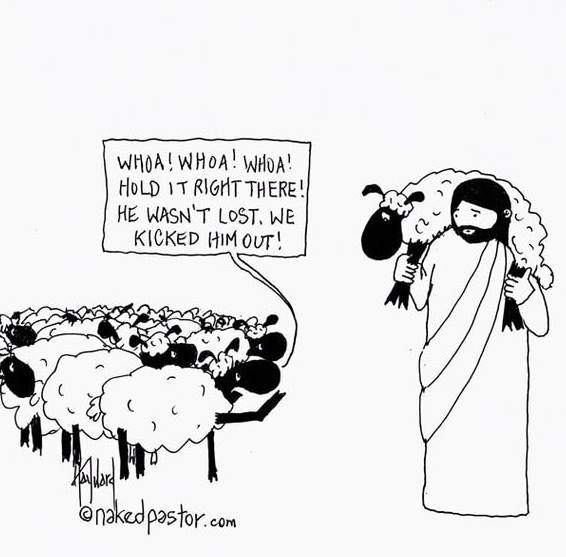
(Note: Cartoon is courtesy of David Hayward, nakedpastor.com. David holds a Master of Theology and a Diploma in Ministry and has over 30 years professional pastoral experience. He lives in New Brunswick, Canada.)
Matthew 18

Sunday church bulletin notice: Our good pastor is gone today looking for the sheep we kicked out of the fold during this past year as the last step of our Matthew 18 conflict resolution policy.
While conflicts are hardly ever fun, imagine how “not” fun it would be to find yourself the subject of a “Matthew 18 process” instituted by someone who strongly adheres to law. Although a legalist would certainly make the Matthew 18 process more difficult than if it were led by a person of mercy, the problem lies with the process rather than with the people involved.
In this writing I will share my view that this widely accepted process is flawed and dangerous when used as a tool for Christian conflict resolution because it’s very foundation is formulaic and legalistic.
So how did I acquire such contrary thoughts about the widely accepted process? What prompted me to look deeper into the meaning of Matthew 18?
I was involved with a ministry group for nearly a decade when the leader, who believes and teaches that Matthew 18 is Jesus’ model for conflict-resolution in the Church, made certain accusations against our group as a whole and also against some individual members. Our group denied any wrong-doing and tried to re-negotiation the terms of our relationship with this leader.
What followed was a series of phone calls and emails from the leader attempting to bring us into compliance with his demands. Through much soul-searching, prayer and discernment we decided to stand our ground and continued to press in for a mutual relationship re-negotiation.
In return, the leader instructed that we have no further contact with him.
All the years of walking closely together in the same direction ended because the leader decided that our dismissal was the appropriate step to end the conflict.
Clearly, this was not the outcome that should be expected from Christians involved in conflict. However, the common interpretation of the final step of the reconciliation process, which many in the Body of Christ believe Jesus instituted as the model His church should follow, is to remove (or excommunicate) the offender.
And lest one thinks that this critical view is totally drawn from this lone experience, I’m hear to tell you I have been a part of, or privy to, two other attempts to use Matthew 18 for resolving conflict. In both cases there were no good results and in one of the cases it was disastrous. In fact, in all my many years of life as a Christian, living in two countries and being in association with virtually every part of the Body of Christ, I haven’t encountered anyone who can testify to the process actually resolving conflict.
Now, obviously, I haven’t heard about every Matthew 18 situation but the lack of readily available evidence to dispute my own experience makes questioning the accepted interpretation and application of this as a credible conflict resolution model appropriate.
So, allow me to ask a few questions about Matthew 18 that are weighing heavy on my mind.
Was Jesus really telling His audience, the very ones He was leading into greater truth, that they should still apply the old law in their treatment of each other? Was Jesus reaffirming, with just a slight variation, Deuteronomy 19:15 (concerned with convicting a person of a crime or wrongdoing) as the best way to resolve serious relationship conflicts?
Or was Jesus simply revealing to them what was in their minds and hearts? Was He taking them to the brink of what they would be willing to do to resolve their differences?
Don’t the verses that comprise the “Matthew 18 resolution conflict model” come into direct contrast to what Jesus says about forgiveness in all the other verses of the same chapter? Wasn’t Jesus’ response to Peter’s question about how often he should forgive others pointing his listeners to something far beyond the letter of the law? “Lord, if another member of the church sins against me, how often should I forgive? As many as seven times?” Jesus said to him, “Not seven times, but, I tell you, seventy-seven times.” (Matthew 18 21-22).
Did Paul teach a legalistic approach to conflict resolution among followers of Jesus Christ? Wasn’t Paul’s message completely based on living with each other “with all humility and gentleness, with patience, bearing with one another in love, making every effort to maintain the unity of the Spirit in the bond of peace?” (Ephesians 2-3)
And didn’t Paul speak in direct deference to Matthew 18 in Colossians 3:12-13? “As God’s chosen ones, holy and beloved, clothe yourselves with compassion, kindness, humility, meekness, and patience. Bear with one another and, if anyone has a complaint against another, forgive each other; just as the Lord has forgiven you, so you also must forgive.”
Now get ready because I am going to ask the quintessential question that turns the popular interpretation of Matthew 18 on it’s ear.
Did Jesus take us through a Matthew 18 process in order for us to receive forgiveness for our transgression against God or did He simply lay His life down for us?
Knowing the ultimate of what Jesus did for us, without anything being required of us (Romans 5:8), I have to believe that we’ve missed something important about what He was saying and meaning in Matthew 18.
I have to believe that Jesus wants us to always forgive, always bear with one another, and always choose unity over division.
So who’s with me? Let’s go out together to look for all those “lost sheep” and return them to the fold with no conditions.
And, as far at Matthew 18 goes, let’s continue to seek wisdom from the Holy Spirit and not accept any interpretation until it absolutely lines up with the character and nature of our God who loves and forgives unconditionally.
(Note: Cartoon is courtesy of David Hayward, (nakedpastor.com). David holds a Master of Theology and a Diploma in Ministry and has over 30 years professional pastoral experience. He lives in New Brunswick, Canada.)
Talking death
Have you ever attended a Death Cafe?
You probably didn’t even know that such a thing existed. I didn’t either until I started researching (prompted by the Holy Spirit) the subject of death; specifically how it relates to living in the Kingdom of Jesus Christ.
According to the sponsor’s website, Death Cafe is a gathering were you eat cake, drink tea, and discuss death. “Our objective is to increase awareness of death with a view to helping people make the most of their (finite) lives.”
The first Death Cafe is said to have met in an East London basement in 2011. The organizer was Jon Underwood, a 40-year-old Web designer. Since 2011, there have been over 7,000 Death Cafes offered in 60 countries.
The idea for the Death Cafe came about as Underwood, who was a Buddhist, pondered the writings of Bernard Crettaz, a Swiss sociologist and ethnologist. Crettaz wrote about the rites and customs that accompany death in society. Following the death of his own wife, Crettaz held the first Cafe Mortel in Geneva, Switzerland.
Crettaz’ idea, which Underwood adopted, was to normalize talking about death in order to dispel the myths, misunderstanding, and fear.
The premise from which Crettaz and Underwood operated is that death is the ultimate “elephant in the living room.” Everyone knows it is there but no one wants to talk about it. Consciously and unconsciously, according to the experts, death is something the average person thinks about a lot but something the average person seldom speaks out loud. This same average person chooses, rather, the rosier path where thoughts of death are quickly dismissed, where the reality of death is denied, and where the subject of death is categorized as pointless and always depressing.
Living in a world where death is inevitable and a constant occurrence makes ignoring this enormous, smelly household beast difficult, if not impossible. But most try any way.
Sociologists say that death has always been a difficult subject for humans and that time has not lessened the fear and anxiety. In fact, evidence is showing that peoples’ negative emotional response about dying is actually increasing. With the major factor being that fewer people hold religious beliefs in modern society.
That should be extremely good news for we Christians. After all, our belief is centered on a God who became Man and was born to die. In fact, we celebrate His death and His resurrection with equal passion. The death of Jesus Christ is precious to Christians.
In the Body of Christ, Catholics probably focus the most on death since Jesus’ death (and resurrection) is front and center at all Masses, which are held daily all over the world. “We hold the death of our Lord, deep in our hearts,” is the opening line of a popular Catholic hymn written by David Haas and epitomizes an important aspect of the faith. (Hear the song and see the lyrics here.
Eucharist is entirely about the death – and resurrection – of Jesus. This “breaking of the bread” ritual commemorates Jesus giving Himself over to death on the cross. It is only through His death – and resurrection – that we can be freed from the hold that sin has on us in order to fully accept the unconditional love and forgiveness of God.
Attending a recent funeral of a relatively young friend, her death and the death and resurrection of Jesus were linked by family members as they spoke about their loved one’s journey. Her belief that Jesus willingly died so she could know and accept the love and forgiveness of God, was what sustained her through the years after the cancer diagnosis.
Her genuine love for Jesus lessened her anxiety and fear of death to almost non-existent. “For now we see in a mirror dimly, but then we will see face to face. Now I know only in part; then I will know fully, even as I have been fully known,” Paul wrote in 1 Corinthians 13:12. This is the same Paul who wrote later in 1 Corinthians 15:31, “I die every day.” Translated from the original text, Paul was expressing his daily awareness of the reality of his own physical death. There is no doubt that Paul had little, or no, anxiety and fear of death. He actually looked excitedly forward (as did my friend) to the day when he would “know fully.”
Death Cafe should be a place where Christians flock. We should love talking about death. And there are a myriad of discussions Christians can have around the subject.
How about that scripture calls death the enemy of God and in 1 Corinthians 15:16 Paul writes that it will be the last enemy destroyed? Does this mean that making peace with death or accepting death as inevitable is cooperating with an enemy of God? Does this mean that we should fight furiously against death at all times and in all situations?
Is death “destroyed” when we begin to live fully in the Kingdom of Jesus Christ and when he have all “come to the unity of the faith and of the knowledge of the Son of God, to maturity, to the measure of the full stature of Christ (Ephesians 4:13)”? It would seem that once matured to the “full stature of Christ,” we would be so focused on God and His plans and purposes that we would have no fear of anything life brings; including death.
Another good question for Death Cafe discussion would be “Why do we die?” A possible answer from the Christian viewpoint would be that we die to enter fully into God’s unconditional love and forgiveness which is fully available to us during life but what we simply can’t or won’t enter into in the land of the living. This inability for humans to wholly accept God’s unconditional love and forgiveness during life could be rooted in the truth that in doing so we have to accept that God’s unconditional love and forgiveness is not only for me but for everyone equally. And this gets us on to another discussion about forgiveness but we will hold that until another blog.
Still another good question for Death Cafe is about Paul’s writing in I Corinthians 15:56: “O death, where is they sting? O death, where is your victory.” He goes on to explain in this passage that the sting of death is sin and that the power of sin is the law. So as we move away from sin and the law into repentance, forgiveness and freedom in Jesus Christ, does the sting and victory of death go away?
Yet another good question is Paul’s emphasis on death being the last enemy to be destroyed. Does this indicate Godly order? Charles Spurgeon, a mid-17th century Baptist preacher, suggested that Paul’s words do indicate an appointed order and that we need to let the last be last. “I have known a brother wanting to vanquish death long before he died,” Spurgeon said. “But, brother, you do not want dying grace till dying moments. What would be the good of dying grace while you are yet alive? A boat will only be needful when you reach a river. Ask for living grace, and glorify Christ thereby, and then you shall have dying grace when dying time comes.”
Another Spurgeon quote (from a sermon titled “Dying Daily”) that would be good discussion material for Death Cafe, is his seven steps to how we can die daily as Paul did. The seven are:
• Every day seriously test your hope and experience.
• Come every day, just as you did at conversion, to the cross of Jesus.
• Live in such a manner that you would not be ashamed to die at any moment.
• Have all your affairs in order so that you are ready to die.
• Every day carefully consider the certainty of death.
• By faith put your soul through the whole process of death.
• Hold this world with a loose hand.
Coffee and cake anyone?