Safe in our weakness

strength_made_perfect_in_weakness.12144811_std.jpg (500×179)In a previous post, we wrote about God’s definition of “covering” as His covenantal promise to never use His superior strength against us. Now, we look at the other side of that same coin: i.e. God’s covenantal promise to never use our weakness against us.
In any relationship where there is an expectation of intimacy (into-me-see) and transparency, trust is paramount. Consider Samson, who naively allowed Delilah to “see into” him. Discovering his weakness – his hair – she participated in an enemy plot to shave Samson’s head. This eventually led to his demise.

     Married couples can experience this same phenomena. After a day battling in the world, they come home seeking safe haven, remove their hard, heavy “armor,” and don soft, light “tunics” which leaves them wide open and vulnerable. Any attack, even if it’s merely a verbal one, can be devastating and cause irreparable damage. Our need for intimacy with one another can be used against us, and in the hands of someone who is not trustworthy, it can set the stage for hurt, manipulation, and control.
     In the garden, after eating of the tree of the knowledge of good and evil, Adam and Eve knew they were literally and figuratively exposed and quickly donned fig leaves to hide themselves. Of course, God knew everything that had transpired and was not the least bit surprised at their actions. But instead of using their weakness against them, He provided more substantial clothing so they could better survive the consequences of their choices. And, He set into motion the plan to restore them into full “pre-fall” relationship with Him.
    Little did they realize that God’s intention was never to harm them. Rather His restorative plan was to reveal Himself, through His son, even more intimately and vulnerably to His creation. Jesus spent His entire earthly ministry advancing the truth about His Father; i.e. How much He loves His creation and that He loves and forgives, unconditionally.
    Jesus also revealed the truth about our human condition; that we have freedom to choose or reject God, just as Adam and Eve did in the Garden. Also that through free will, given as a gift from God when we were created, we can decide to live independent from God, and end up hurting each other and defiling God’s creation.
     But Jesus came to show us a more excellent way; that an intimate relationship with Him and dependence on God the Father results in true freedom and abundant life.
     Jesus also came to show us that we can trust God. That He is true to His promises. That God is for us and never against us. That we can show our weaknesses before God and He will cover us.
     This is what Paul meant in 2 Corinthians 12:9 when he said God’s grace – unmerited favor – was sufficient for him.
     Because God is for us, we can provide others with “sacred spaces” where their weakness will not be used against them; a place where God will cover them and healing and wholeness can happen.


The world needs shalom pursuers

    Peacemakers Bookmark

     Jesus declared “Blessed are the peace makers . . .” (Matthew 5:9)
     The Hebrew words which Jesus used can be translated, according to some biblical scholars, as blessed are the “shalom pursuers.”
     This translation brings His declaration in line with the words and actions displayed throughout His public ministry.
     Peace – shalom – was His often repeated greeting to His disciples. John 14:27 records Jesus’ words to those who were with Him at supper: “Peace (shalom) I leave with you, my peace (shalom) I give you,” he is recorded as saying.
     And then He goes on to qualify the shalom He is giving: “I do not give to you as the world gives.”
     In other words, this shalom is “other worldly.” And the inference is that Jesus’ shalom is far greater than anything the world would call peace.
     The dictionary definition of peace is “a state of quiet and tranquility.”
     Shalom incorporates that definition of peace and expands it with “harmony, wholeness, and completeness.”
     In Jesus’ “sermon on the mount” declaration, He was describing the peace maker (the shalom pursuer) who would stand before the fearful group in the locked house after His death and resurrection. “When it was evening on that day, the first day of the week, and the doors of the house where the disciples had met were locked for fear of the Jews, Jesus came and stood among them and said, ‘Peace be with you’.” (John 20:19)
     In that room, filled with fear and anxiety, Jesus pursued shalom and then flooded it into the situation and to everyone there. Jesus’ shalom filled every crack and crevice with peace, tranquility, harmony, wholeness, and completeness.
     This is the picture of what Jesus was talking about when He said “Blessed are the peace makers (shalom pursuers).”
     Shalom pursuers come into a space and infuse everything, everyone, and, indeed, the very atmosphere with shalom.
     Jesus spoke the words “Blessed are the peace makers, for they shall be called sons of God” over 2,000 years ago, but His declaration is just as applicable for us today.
     Three actual modern day examples of “shalom pursuers” in action:
  1. The city’s leaders were made aware that a level three sex offender was intending to move into one of their neighborhoods. Fear set in among the people. Christian leaders in the city came together to pray about the situation and “shalom” came upon them. Fear lifted. They became excited to welcome the young offender back into the community since It was learned that he was a former resident. The Christian leaders began to pray for him, always using his first name, and prepared to serve him in whatever way the Lord directed. Shalom seemed to come over the entire community as the day for the young offender’s move came closer. No public outcry was heard. At the last minute, the young offender decided not to move to the city. There was actually disappointment expressed by the church leaders. They continued to pray for him.
  2. News of a local bank robbery spread quickly throughout the small community. It soon became known that one of the bank robbers was a young resident of the community. The robbers turned themselves in and were sentenced to serve jail time. A few weeks after the sentencing, one of the bank robbers walked into the weekly community prayer meeting escorted by a regular meeting attendee. With the bank robber sitting among them, the leaders asked if they could pray for her. She told them that she had attended one of the churches in town throughout her childhood years and had even taught confirmation classes there. “I don’t know where I went wrong,” she said sobbing. Spontaneously, the male leaders at the meeting knelt before her and asked forgiveness for anyway they, as fathers of the community, had failed her. A local government official prayed for her. “I can’t release you from the consequences of your actions,” she said “But I can say on behalf of the community that you are forgiven.” Shalom filled the room with peace, tranquility, harmony, wholeness, and completeness.
  3. A young Christian women attending a friend’s wedding was seated next to a girl who had always been rude to her whenever they met. The young women never understood the reason behind the girl’s cruel treatment. The girl was now the one being treated rudely and was shunned by other’s at the wedding who were close friends of her ex-boyfriend. The young women felt compassion for the girl and spent most of the evening talking with her. By the end of the evening, the girl indicated that she would like to get to know the young women better and suggested that they meet in the near future. The young women’s kindness to the girl was noticed by others at the wedding and it inspired an outpouring of greater friendliness and respect throughout the group.

     Shalom is the opposite of drama, of anxiety, of anything that would stem from fear. Shalom was the lifestyle of Jesus Christ and we are invited to pursue the same shalom within ourselves and let it flow out into the world. What would hold us back from the desire to be shalom pursuers?

Recovering from covering  

Image result for rainbow
     “Covering” is a word that has become common nomenclature in the New Apostolic    Reformation (NAR), a Christian movement focused on advancing the Kingdom of God in the world.
     Many in the movement put apostles in the highest authority and the ones who provide leadership, direction, and spiritual “covering.” They see 1 Corinthians 12:28 as biblical justification for this leadership structure: “And God has appointed in the church first apostles, second prophets, third teachers.”
     What is missed from this conclusion, however, is that “forms of leadership” is also in Paul’s list and actually mentioned second to the last: “Then deeds of power, then gifts of healing, forms of assistance, FORMS OF LEADERSHIP, various kinds of tongues.”
Could it be that Paul’s list was in “foundation-building” order rather than descendent authority?
     Throughout the church’s existence, the practical application of apostolic “covering” has shown to be greatly problematic. Where ever Christians have looked to someone other than God as a kind of spiritual insurance, the stage has been disastrously set for leadership abuse, particularly when a leader is consciously or unconsciously seeking power and using it to advance their own personal agenda. In these cases, apostolic covering has become a costly service paid with tithes and obedience.
     And this is in stark difference to what Jesus taught in Luke 22:24-27: “Now there was also a dispute among them, as to which of them should be considered the greatest. And He said to them, ‘The kings of the Gentiles exercise lordship over them, and those who exercise authority over them are called ‘benefactors.’ But not so among you; on the contrary, he who is greatest among you, let him be as the younger, and he who governs as he who serves. For who is greater, he who sits at the table, or he who serves? Is it not he who sits at the table? Yet I am among you as the One who serves.”
     In God’s Kingdom, leadership is entirely about service, PERIOD.
     So is there any truth to the NAR teaching about apostolic covering? The answer is “yes” if “covering” is a covenantal promise that “I will use my strength (in whatever form) for you and never against you.” Like a safe haven under protective wings. Think of the rainbow in the story of Noah and the ark. It is God’s radiant reminder that He is a covenant-keeper and will not use His strength against His creation.
     Consider the story of Adam and Eve in the garden after “the fall.” They hid from God because they were afraid He would use His power against them. They feared that the one who had been their loving daily companion would become their angry chastiser.
     What they feared, however, was not the truth. Instead, God in His unwavering kindness extended grace, covered them with “garments of skins,” and sent them from the Garden of Eden to protect them from living eternally in their fallen/wrong-thinking condition. He already had a plan in mind to restore them to full relationship with Him. He would not use His strength against them.
     Another example of covenantal “covering” are the promises made between a man and woman in Christian marriage. In this covenant, the couple pledges to live “for” and not “against” one another. Because of this covenant, as it states In Proverbs 31:11, the couple can entrust their hearts to each other without fear.
     Medical doctors, who wield immense power over vulnerable patients, covenant with them by taking the Hippocratic Oath and profess to “First do no harm.” They pledge to use their strength, their knowledge, their experience for their patients and never against them.
     So it must be with any form of leadership existing in the Body of Christ.


Changing the rules

An all too common occurrence in the Body of Christ today:

Denomination: You, church, are out of agreement with one (or more) of our core beliefs.

Church: We are just following what we have come to believe is true.

Denomination: We can’t have you professing an opposing belief and staying in affiliation with us.

Church: Can’t we talk about this?

Denomination: Talking is over. Either recant, leave, or be removed from our midst.

Church: We can’t recant and don’t want to leave.

Denomination: It’s time to vote.

Church: Can’t we talk about this?

Denomination: The “ayes” have it. You are removed. Good bye.

     Now, this isn’t always the way it goes. Sometimes, the church leaves on its own. Rarely, the church recants. But often, the church attempts to stay and, in the end, the denomination votes to remove them or formally reestablishes the disputed belief as an absolute requirement of membership.
     This scenario is actually as old as the Christian Church itself. What makes it a contemporary occurrence is what is being disputed. Ancient schisms were primarily over “substantial matters” concerning divine truth. Today, the disputes are many times concerned with morals: i.e. right and wrong human behavior.
     But, it is interesting that the current disagreements about morals, often carry the same seriousness and consequences as those over substantial matters.
     So having defined the situation, we pose a few questions:  Is this scenario a good thing?; Is this a satisfactory outcome?; Is there a better way?
     You might think that we will now proceed to provide answers to the questions we proposed. But, guess what? We will not be providing answers here or any where else, for that matter.
     By not answering we are making our point that the debate over morals doesn’t belong in the Kingdom of God (the church) in the first place. Debating right and wrong human behavior is strictly a kingdom of the world thing.
     Whenever the church gets pulled, by the world, into deciding how people should or should not behave, it gets itself into a position of either condoning or condemning. This is a “pick one” position that is opposed to God’s “all” character and nature. There is immense wisdom for the church in Jesus’ statement recorded in Matthew 7:1, that we are not to judge.
     And it has been shown over many centuries of moral debate (on such things as abortion and homosexuality) just how unsuccessful and damaging is judging behavior.         What has been gained by all the disagreeing and voting? Almost nothing except for division among brethren and derision from the world.
     While on the earth, Jesus never engaged in moral debate. In fact he went to great lengths to show his acceptance of everyone regardless of their behavior. He fellowshipped with prostitutes and ate with tax collectors.
     Even when pulled smack dab into a the middle of a moral dilemma, Jesus refused to play by the world’s rules.
     This is the story of the adulteress woman in John 8. Jesus is in the temple courts where “all the people” are gathered around Him. The scene is interrupted as a woman “caught in adultery” is made to stand before Jesus and the crowd.
Jesus is challenged by the “teachers of the law and the Pharisees” to agree that the woman should be stoned for her behavior.
     Faced with this moral decision, it seems that Jesus had no option but to either condone her behavior or condemn her to death.
     But He refused to play by the rules of the world. He would neither condone nor condemn.
     Without a word, He bent down removing himself from the fracas. He closed off the voices of those around Him and, instead, sought the quiet voice of His Father.
     When Jesus rose, the words He spoke cut through the tension and shattered the debate into a million pieces. “Let anyone of you who is without sin be the first to throw the stone at her.” (John 8:7)
     Having spoken what He had heard from His Father, Jesus stooped down again confident that those 18 words would do exactly what the Father willed. He wouldn’t be disappointed.
     “At this, those who heard began to go away one at a time, the older ones first, until only Jesus was left, with the woman still standing there,” wrote the gospel’s author in John 8:9.
     And when (and only when) the din and chaos are gone, He again gets up. Now alone with the woman, He can speak calmly and directly – just to her. The scene turns from a public spectacle to one of great intimacy: She, a frightened, desperate woman and He, her loving Savior. With the world out of the way, Jesus turned His full attention to doing what His Father had sent Him to do.
     Jesus’ primary mission is totally depicted in the conversation that followed: “Woman, where are they? Has no one condemned you?” Jesus asks (John 8:11). “No one, sir,” she said. “Then neither do I condemn you,” Jesus declared. “Go now and leave your life of sin.”
     What an amazing outcome. Jesus fulfilled the Father’s mission despite the world’s attempts to distract Him from that mission.
     This is how Jose Antonio Pagola (author of the Group of Jesus website) puts it: “That’s how Jesus is. Finally there existed in the world someone who hasn’t let himself be conditioned by any oppressive law or power. Someone free and magnanimous who never hated nor condemned, never returned evil for evil. In his defense and his forgiveness of this adulterous woman there is more truth and justice than in our resentful demands and condemnations.”
     Likewise, the Church would do better to resist engaging in the world’s battles, played by the world’s rules, using the world’s wisdom. We can choose instead to seek God’s wisdom and act in complete accord with Jesus’ anointing “to proclaim release to the captives and recovery of sight to the blind, to let the oppressed go free.” (Luke 4:18)


What about those angels!

Related image “Wow” is a common response to reports about encounters with angels.

It seems that everyone marvels when angels take front and center in stories like:

     • A single mother with two infants was driving her “old clunker” of a car home when it started to sputter. Realizing that she was about to run out of gas, she took the next exit ramp which just happened to be slightly uphill. Almost at the top of the hill, her car died. Looking around she could see nothing except empty fields and the distant lights of a truck stop about a quarter of a mile down the road. With no cars in sight and no cell phone, she looked at her two young children asleep in their car seats and began to despair. She put her head on the steering wheel and started praying. Suddenly, a few taps on the window brought her back to reality and when she looked up she saw a clean-cut young man standing there. He motioned that she should roll down the window. Without the slightest fear, she rolled down the window and listened as the young man explained that he would help her over the hill and then to the truck stop at the bottom of the exit. He told her to put the car in neutral and she soon felt the car moving. Once over the hill, she steered toward the truck stop. The car kept moving until it reached the gas pumps. Her children never woke up. As she looked around to thank the young man, there was no one in sight.

  • A young woman was skiing down an unfamiliar slope. Eager to get going, she missed a sign that would have directed her safely down the hill. Around a corner she encountered a man completely dressed in black. He was directing her to go in a different direction than she was headed. His sudden appearance caused her to fall and when she looked up he was gone, leaving no tracks in the snow. Examining the spot of her meeting with the man dressed in black she discovered that if he had not distracted her she would have skied right over an outcropping. It occurred to her later that the “angel” was wearing black so that she could clearly see him against the white background of the ski hill.
     Belief in angels is widespread among Americans. A 2016 Gallup poll found that 72 percent of the respondents said they believe in angels.
     And, it isn’t any surprise that Christians are the biggest believing group. This is, most likely, attributed to the fact that angels are mentioned almost 300 times in the Bible.
     Such as when it is reported in Luke 22:43 that angels appeared to Jesus “strengthening Him” during his time of agony in the Garden of Gethsemane. And when angels “in white” appeared to Mary as she looked into the tomb of Christ (John 20:11-12).
     Also the incredible story in Acts 12 about Peter’s release from prison: “The night before Herod was going to bring Peter to trial, Peter was sleeping between two soldiers. His hands were bound with two chains, and guards were in front of the door. They were watching the prison. Suddenly, an angel from the Lord stood near Peter, and his cell was filled with light. The angel nudged Peter’s side, woke him up, and said, ‘Hurry! Get up!’ At that moment the chains fell from Peter’s hands. The angel told him, ‘Put your shoes on, and get ready to go!’ Peter did this. Then the angel told him, ‘Put your coat on, and follow me.’ Peter followed the angel out of the cell. He didn’t realize that what the angel was doing was actually happening. He thought he was seeing a vision. They passed the first and second guard posts and came to the iron gate that led into the city. This gate opened by itself for them, so they went outside and up the street. The angel suddenly left Peter.”(Acts 12:6-10)
     But, what about angels today? What are they for? What do they do? How are we suppose to think about them?
     First of all, angels are similar to humans in that they are God-created beings with God-given free will. But this is where their similarity with humans ends. Angels are spirit; they are things of heaven. However, they have been known to “appear” on earth and in human form but only for God-ordained specific purposes. This was certainly the case during Jesus’ life on the earth.
     Belief in angelic beings is definitely used by God to inspire humans to think about the “unseen.” Angel-encounter stories have a tendency to raise our thoughts above the things of the earth and into the heavenly realm. The existence of angels is also used by God to inspire a “child-like” faith within us.
     However, we have plenty of examples in the Body of Christ today of an unhealthy preoccupation with angels. This ranges from their being used to gain some benefit to the actual worship of them.
     Whatever form this may take, too much focus on angels has the tendency to distract us from our relationship with God. In fact, a preoccupation with angels is a symptom of a lack of intimacy with our unconditionally loving and forgiving Father.
     We need only look at Jesus as the example of a healthy posture toward angels. Jesus wasn’t preoccupied with angels even though He had plenty of interaction with them. His attitude was that angels were creatures of God who were there to serve. In other words, they were just there to do what God had created them to do.
     Their existence certainly helped Jesus during His time on the earth. They heralded His birth in a way that was appropriate for a King (Luke 2:10-12); they ministered to Him at times of great personal need (Matthew 4:11 and Luke 22:43); and they provided a sense of confidence in His Father’s protection: “Or do you think that I cannot appeal to My Father, and He will at once put at My disposal more than twelve legions of angels?” (Matthew 26:53).  Angels made Jesus’ return to the Father glorious (Act 1: 9-11).
     Angels are evidence that heaven is all around us. They serve as a reminder that extraordinary things happen every day of our lives. Their existence is meant to help us feel safe and protected by a faithful and trustworthy God.
    But the truth is that being in relationship with our unconditionally loving and forgiving Father is more extraordinary than any angel encounter. Angels do God’s bidding and they should inspire us to turn our hearts toward him.
     An absolute right way to think about angels is to be thankful. We don’t need to entirely understand why God created angels in order to thank Him for them. All we need to know is that God created them and, therefore, they are good and their purpose is good.

Faces in the mirror

Jesus came to  bring good news to the poor.
Jesus came to bind up the brokenhearted.
Jesus came to proclaim liberty to captives.
Jesus came to release the prisoners.
     All this proclaimed by Jesus, as He read from the Book of Isaiah standing in the synagogue in Nazareth at the beginning of His public ministry.
     And then, as the days of His time on the earth began to unfold it became clear that Jesus also came to reveal God. He did this through what He said (John 12:49) and did (John 5:19). Making this as clear as He could, Jesus said, “Whoever has seen Me, has seen the Father. (John 14:9)” and “No one has seen God at any time; the only begotten Son, who is in the bosom of the Father, He has declared Him” (John 1:18).
     A particular aspect of God, revealed by Jesus was God as Father. “The idea of God being a heavenly Father was not a popular or common concept among the Jews,” wrote Dennis Pollock, evangelist and teacher for Spirit of Grace Ministries, McKinney, TX. “There are a couple of Old Testament references to God as Father, but this idea had never really caught on with the Jews. God was too holy, too strict, too remote, and too distant to think of Him as Father. And yet Jesus insisted this was how we were to begin our prayers, reminding ourselves at the outset that we were in a loving relationship with our divine Maker.”
     Jesus taught that God is a loving Father. (1 John 3:1). Jesus taught that our Heavenly Father is very generous. (Matthew 6:25-26). Jesus taught that our Father is intimately involved in and aware of us and our circumstances. (Matthew 10:29). 
     An added element of Jesus’ ministry, one that gets little attention from biblical teachers, is that He came to reveal the condition of man. In other words, He came to reveal us to us.
     That this gets missed more often than not, is surprising given the fact that the human condition is what Jesus talked about and pointed out, a lot. Every parable, every teaching, every sermon is primarily about how we treat each other, how we think, how we act.
     Unfortunately, too many times we don’t see clearly when Jesus is describing our human condition and mistakenly attribute what He is saying to how God thinks and acts.
     This is especially problematic when the human-based parable characters are interpreted as Jesus painting a caricature of God the Father. The father in the Prodigal Son story is one of these often misinterpreted characters. The father in the story displays some God-like characteristics (he is extremely forgiving, long suffering, and loving), but he is still very human-like in many ways and stops short of being an accurate portrait of our Heavenly Father.
     It might be a little easier to accept this about the nobleman in the Luke 19 Parable of the Ten Talents. Suggestions that Jesus (God) is the nobleman in the story, paints a wrong picture of the Heavenly Father whom Jesus came to reveal. In the story, the servants who invested the master’s money risked disappointing him by making unwise investments. Fear reigns in the story as the nobleman is described by one servant as a “harsh man” and then he proves the truth of this statement by ordering his enemies be slaughtered in his presence.
     It isn’t hard to imagine the agreement, among Jesus’ audience, of the nobleman’s actions. This is how they did things. This is what they probably believed was right and just.
     Our perspective of the story, however, should be influenced by what comes before and after it’s inclusion in the Bible. Just before the Parable of the Ten Talents, Luke 19 opens with Jesus’ encounter with Zacchaeus, the chief tax collector. As a tax collector for the Romans, Zacchaeus, a Jew, was considered “a sinner” by the Jews at that time. (Luke 19:7)
     But Jesus ignores Zacchaeus’ reputation and his position of authority and purposes that he “must stay” at the tax collector’s house. And, as Luke unfolds the story, we quickly see Jesus being about His Father’s business. Close to Zacchaeus and his family, Jesus announces that “salvation has come to this house” and restates His primary mission given by His Father, “For the Son of Man came to seek out and to save the lost.” 
     Luke’s two stories following the parable of the Ten Talents both describe Jesus acting in accord with His intention to “reveal the Father.”
     In Luke 19:28-40, God the Father is revealed as Jesus humbles himself riding a young horse through the streets of Jerusalem in order to get eye-level with His hurting children. And in Luke 19:-41-44, Jesus reveals the compassion and love of God the Father as He weeps over the coming destruction of Jerusalem and it’s inhabitants.
     Jesus often applied “God-like” characteristics to the king or master or lord or nobleman characters in his parables. But no matter how good or wise or merciful He made them, none are accurate representations of our all-wise, all-loving, and all-forgiving God. If we are honest with ourselves, we can see that it is us and our behavior reflected through the parable characters.
     Jesus didn’t need to talk about God the Father in allegory as a way to reveal Him to the world. The world had Jesus standing right in front of them as the actual, bonefide flesh and blood representative of His Father. “This is my beloved son, in whom I am well pleased. Listen to him.” (Matthew 17:5)
     What Jesus showed through His parables was the best and worst of what humans can be and do under law. This is an important point to get since, as Paul explained in Romans 3, the law was purposed by God to expose sin and show that even perfect adherence to law cannot bring righteousness. “In order that the blessing (promise) given to Abraham might come . . . through Christ Jesus, so that by faith we might receive the promise of the Spirit.” (Galatians 3:14)
     Through the parables, Jesus was telling us “this is what you do” but then pointed to the more excellent way. 
     It is important that we allow the mirror (Jesus holds up through the parables) to reflect back to us our true human condition. Then we can see the ways in which are we oppressed and brokenhearted, captives to our condition, and how desperately we need a Savior.
Illustration from Chabad.org.


Mellifluous harmony

canstockphoto26814516-1.jpg

     (This is a repost. It was first published in March of 2019. This description of the Trinity’s incredible relationship, which we have all been born into, as mellifluous harmony is too wonderful to only post once. Enjoy!)

     The title of this blog post might seem a bit redundant. Mellifluous and harmony are very close in meaning. In fact, mellifluous has harmonious in its dictionary definition and harmony has mellifluousness in its definition.

     The use of these two very similar words in one title, however, is intentional since this post is about the relationship of the Trinity: i.e. the Father, Son, and Holy Spirit. Trying to describe this unique and special relationship takes some unique and special words.

     Since harmony (a noun) is the more familiar of the two words, let’s look at its meaning first.

     “Accord, agreement, peace, peacefulness, amity, amicability, friendship, fellowship,  cooperation, understanding, consensus, unity, sympathy, rapport, like-mindedness; unison, union, concert, oneness,” are a few synonyms from the dictionary. Clearly, every word defining harmony can be attributed to the relationship of the Trinity.

     But harmony alone doesn’t describe the depth and quality of the Trinity’s relationship. So in our humble attempt to get closer, we add mellifluous, a less familiar adjective.

     Expanding harmony with a word that means “honeyed, mellow, soft, liquid, silvery, soothing, rich, smooth” comes closer to the truth revealed by Jesus in John 16: “I still have many things to say to you, but you cannot bear them now. When the Spirit of truth comes, he will guide you into all the truth, for he will not speak on his own authority, but whatever he hears he will speak, and he will declare to you the things that are to come. He will glorify me, for he will take what is mine and declare it to you.  All that the Father has is mine; therefore I said that he will take what is mine and declare it to you.” 

     Still better, we invite the voice of C. Baxter Kruger, author of The Shack Revisited, to get even closer. “For this trinitarian relationship, this abounding and joyous communion, this unspeakable oneness of love, is the very womb of the universe and of humanity within it.” (The Shack Revisited, 2012, Faithwords, Hachette Book Group, Inc, page 115) 

     The truth of the perfect, loving,  mellifluous harmony between the Father, Son and Holy Spirit of the Trinity is portrayed throughout the Bible.  But there is no better evidence that the Creator of the Universe has a unified three-in-one expression than the desire of His creation to live in loving relationship with others.

     Part of being made in the image of God (Genesis 1:27), is our strong desire to know and to be known by others. As Kruger puts it, if we had been created in the image of a single-personed God we would choose aloneness over togetherness. As it is, man’s deepest longing is to be in intimate, loving, trusting relationships.

     The creation of man was a result of the mellifluous harmonious relationship of the Triune God. We were created through this oneness and, once created, invited into it.  Is it any wonder that the psalmist frequently uses “honey” as a way to describe the richness and sweetness of God’s love for His creation?

     Pause here for a moment, and let it sink in…the Godhead, the Ancient of Days, the incomparable “I Am,” invites us into this breathtakingly beautiful, eternally perfect, and abundant life-giving love fest. It is difficult to fully appreciate the fact that we have access to such an astounding reality and, then, that it comes entirely by God’s grace.

     Since living in relationship with others is a natural desire of our creation, it would seem wise to know how we should live.

     It is actually very simple. Our relationships should be an extension of the Trinitarian relationship. Mellifluous harmonious relationship is how Christians can and should be living with each other. 

     It would be a mistake, however, to conclude that mellifluous harmony means sacrificing one’s identity. Once again, we can look to the dynamics of the Trinity for our inspiration.

     According to Fr. Richard Rohr, author of The Divine Dance,  the mystery of the Trinity, is that it is a “three-way boundaried relationship” yet each is totally surrendered to the others. “Each person (Father, Son and Holy Spirit) is totally autonomous and yet perfectly given.”

     Since this seemingly oxymoron, self-sufficient autonomy, exists as reality in the Trinity, it can and should also exist in our relationships.

     Fr. Rohr, lecturing on his latest book, states that the Trinity’s openness to one another “does not mean conformity to the other” and that this is only possible because each has a perfect sense of their individuality.

     “Only people who have a strong sense of their individuality can in fact give themselves away freely,” Rohr said.  “You’ve got to, strangely enough, be very sure of yourself to truly give yourself away.”

     In other words, we enter mellifluous harmonious relationship solidly knowing our own unique identity and then our “I” (selflessly and joyously) becomes “we” through the working of the Holy Spirit.

     The Trinitarian mellifluous harmony is the true unity which the Body of Christ so desperately needs.

Matthew 18 (continued)


"Trying to Escape" cartoon by nakedpastor David Hayward

This is a continuation of our previous blog concerning common Christian interpretations and application of the conflict resolution outlined in Matthew 18.

We have already discussed the ways in which God’s character and nature (as revealed by Jesus Christ) are misrepresented in all “throw the bums out” interpretations of Matthew 18. God’s dealing with His creation is always with unconditional love and unconditional forgiveness. And, He requires nothing from us in order for Him to maintain this posture. We are the ones who run into trouble (and plenty of it) whenever we won’t or can’t accept God’s unconditional love and forgiveness for ourselves and others.

Since it isn’t God who requires a Matthew 18 process in order to forgive and fully accept us no matter what, could it be that we are the ones who feel justified in treating others this way?

We believe this is exactly what Jesus was revealing to those He was addressing at the time He spoke what is recorded in Matthew 18. Throughout the first few sentences, they must have thought that the rebellious Jesus really did think just like them, after all.

“If another member of the church sins against you, go and point out their fault when the two of you are alone.” (Matthew 18:15)

Yes, they would and wanted to directly confront the accused with their offense requiring repentance to the “obvious” righteous claim against them.” (Case-in-point: Acts 24:1)

“If the member listens to you, you have regained that one. But if you are not listened to, take one or two others along with you, so that every word may be confirmed by the evidence of two or three witnesses.” (Matthew 18:15-16)

Yes, they would and wanted to drag the unrepentant offender before a few of their friends and enlist their agreement. (Case-in-point: John 8:1-11)

If the member refuses to listen to them, tell it to the church; and if the offender refuses to listen even to the church, let such a one be to you as a Gentile and a tax collector.” (Matthew 18:17)

Yes, they would and wanted to stand the accused before the entire assembly and then shun them if they still refuse to repent and comply. (Case-in-point: Jesus’ treatment at the hands of the Jews after His arrest. Luke 22:66)

You can just hear the minds and hearts of the people Jesus was addressing eagerly agreeing with those first sentences.  “That’s exactly what should be done to THOSE people. This is exactly what THEY deserve. This is the righteous thing to do to THEM. Yes, we should treat them like WE treat gentiles and tax collectors.”

But wait. Doesn’t this last sentence in the process depict a serious divergence between  Jesus and the Jews? Did Jesus treat gentiles and tax collectors in the same manner as the Jews? Of course, the answer is “absolutely not.”

Gentiles and tax collectors were marginalized, avoided and even hated by the Jews. But Jesus talked with them, visited them in their homes, ate with them, healed them, forgave them, and invited them into His Kingdom.

Could it have been that Jesus (inspired by the Holy Spirit) chose the words in Matthew 18 to reveal the hearts of His listeners in order to lead them to the place where His heart rests?

There is no doubt that sin exists in the Body of Christ and there may be a need at times, in the case of serious sin, to confront and help (kindly and lovingly) someone see the error of their ways. But just know, that if you go down the path of Matthew 18, it is expected that you act in accordance with the character and nature of God and, in the end, treat the subject of the conflict as Jesus treated the gentiles and tax collectors.

Also, and this may be the most difficult part, we must (as Jesus did) lay our lives down. When our feelings get hurt, someone offends us, insults us, or spreads lies about us, let  our response be in sync with the Holy Spirit (the Spirit of God) and not our human spirit. This internal reflection usually results in us dropping our offense and desire to do something and, instead, trusting the working of the Holy Spirit to reveal truth in the right time and in the right way. Holy Spirit-inspired repentance always brings freedom, healing and reconciliation where as man-inspired repentance often brings guilt, shame, and division.

Oh, that we could all treat each other as Jesus treated gentiles and tax collectors!

(Note: Cartoon is courtesy of David Hayward, nakedpastor.com. David holds a Master of Theology and a Diploma in Ministry and has over 30 years professional pastoral experience. He lives in New Brunswick, Canada.)

Matthew 18

46002483_10210436149135167_567990728903360512_n


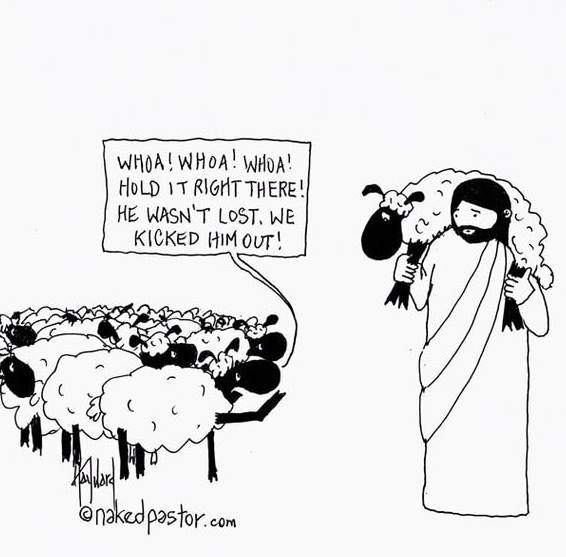
Sunday church bulletin notice: Our good pastor is gone today looking for the sheep we kicked out of the fold during this past year as the last step of our Matthew 18 conflict resolution policy.

While conflicts are hardly ever fun, imagine how “not” fun it would be to find yourself the subject of a “Matthew 18 process” instituted by someone who strongly adheres to law. Although a legalist would certainly make the Matthew 18 process more difficult than if it were led by a person of mercy,  the problem lies with the process rather than with the people involved.

In this writing I will share my view that this widely accepted process is flawed and dangerous when used as a tool for Christian conflict resolution because it’s very foundation is formulaic and legalistic.

So how did I acquire such contrary thoughts about the widely accepted process? What prompted me to look deeper into the meaning of Matthew 18?

I was involved with a ministry group for nearly a decade when the leader, who believes and teaches that Matthew 18 is Jesus’ model for conflict-resolution in the Church, made certain accusations against our group as a whole and also against some individual members. Our group denied any wrong-doing and tried to re-negotiation the terms of our relationship with this leader.

What followed was a series of phone calls and emails from the leader attempting to bring us into compliance with his demands. Through much soul-searching, prayer and discernment we decided to stand our ground and continued to press in for a mutual relationship re-negotiation.

In return, the leader instructed that we have no further contact with him.

All the years of walking closely together in the same direction ended because the leader decided that our dismissal was the appropriate step to end the conflict.

Clearly, this was not the outcome that should be expected from Christians involved in conflict. However, the common interpretation of the final step of the reconciliation process, which many in the Body of Christ believe Jesus instituted as the model His church should follow, is to remove (or excommunicate) the offender.

And lest one thinks that this critical view is totally drawn from this lone experience, I’m hear to tell you I have been a part of, or privy to, two other attempts to use Matthew 18 for resolving conflict. In both cases there were no good results and in one of the cases it  was disastrous. In fact, in all my many years of life as a Christian, living in two countries  and being in association with virtually every part of the Body of Christ, I haven’t encountered anyone who can testify to the process actually resolving conflict.

Now, obviously, I haven’t heard about every Matthew 18 situation but the lack of readily available evidence to dispute my own experience makes questioning the accepted interpretation and application of this as a credible conflict resolution model appropriate.

So, allow me to ask a few questions about Matthew 18 that are weighing heavy on my mind.

Was Jesus really telling His audience, the very ones He was leading into greater truth, that they should still apply the old law in their treatment of each other? Was Jesus reaffirming, with just a slight variation, Deuteronomy 19:15 (concerned with convicting a person of a crime or wrongdoing) as the best way to resolve serious relationship conflicts?

Or was Jesus simply revealing to them what was in their minds and hearts? Was He taking them to the brink of what they would be willing to do to resolve their differences?

Don’t the verses that comprise the “Matthew 18 resolution conflict model” come into direct contrast to what Jesus says about forgiveness in all the other verses of the same chapter? Wasn’t Jesus’ response to Peter’s question about how often he should forgive others pointing his listeners to something far beyond the letter of the law? “Lord, if another member of the church sins against me, how often should I forgive? As many as seven times?”  Jesus said to him, “Not seven times, but, I tell you, seventy-seven times.” (Matthew 18 21-22).

Did Paul teach a legalistic approach to conflict resolution among followers of Jesus Christ? Wasn’t Paul’s message completely based on living with each other with all humility and gentleness, with patience, bearing with one another in love,  making every effort to maintain the unity of the Spirit in the bond of peace?” (Ephesians 2-3)

And didn’t Paul speak in direct deference to Matthew 18 in Colossians 3:12-13? “As God’s chosen ones, holy and beloved, clothe yourselves with compassion, kindness, humility, meekness, and patience. Bear with one another and, if anyone has a complaint against another, forgive each other; just as the Lord has forgiven you, so you also must forgive.”

Now get ready because I am going to ask the quintessential question that turns the popular interpretation of Matthew 18 on it’s ear.

Did Jesus take us through a Matthew 18 process in order for us to receive forgiveness for our transgression against God or did He simply lay His life down for us?

Knowing the ultimate of what Jesus did for us, without anything being required of us (Romans 5:8), I have to believe that we’ve missed something important about what He was saying and meaning in Matthew 18.

I have to believe that Jesus wants us to always forgive, always bear with one another,  and always choose unity over division.

So who’s with me? Let’s go out together to look for all those “lost sheep” and return them to the fold with no conditions.

And, as far at Matthew 18 goes, let’s continue to seek wisdom from the Holy Spirit and not accept any interpretation until it absolutely lines up with the character and nature of our God who loves and forgives unconditionally.

(Note: Cartoon is courtesy of David Hayward, (nakedpastor.com). David holds a Master of Theology and a Diploma in Ministry and has over 30 years professional pastoral experience. He lives in New Brunswick, Canada.)

Talking death

Have you ever attended a Death Cafe?

You probably didn’t even know that such a thing existed. I didn’t either until I started researching (prompted by the Holy Spirit) the subject of death; specifically how it relates to living in the Kingdom of Jesus Christ.

According to the sponsor’s website, Death Cafe is a gathering were you eat cake, drink tea, and discuss death. “Our objective is to increase awareness of death with a view to helping people make the most of their (finite) lives.”

The first Death Cafe is said to have met in an East London basement in 2011. The organizer was Jon Underwood, a 40-year-old Web designer. Since 2011, there have been over 7,000 Death Cafes offered in 60 countries.

The idea for the Death Cafe came about as Underwood, who was a Buddhist, pondered the writings of Bernard Crettaz, a Swiss sociologist and ethnologist. Crettaz wrote about the rites and customs that accompany death in society. Following the death of his own wife, Crettaz held the first Cafe Mortel in Geneva, Switzerland.

Crettaz’ idea, which Underwood adopted, was to normalize talking about death in order to dispel the myths, misunderstanding, and fear.

The premise from which Crettaz and Underwood operated is that death is the ultimate “elephant in the living room.” Everyone knows it is there but no one wants to talk about it. Consciously and unconsciously, according to the experts, death is something the average person thinks about a lot but something the average person seldom speaks out loud. This same average person chooses, rather, the rosier path where thoughts of death are quickly dismissed, where the reality of death is denied, and where the subject of death is categorized as pointless and always depressing.

Living in a world where death is inevitable and a constant occurrence makes ignoring this enormous, smelly household beast difficult, if not impossible. But most try any way.

Sociologists say that death has always been a difficult subject for humans and that time has not lessened the fear and anxiety. In fact, evidence is showing that peoples’ negative emotional response about dying is actually increasing. With the major factor being that fewer people hold religious beliefs in modern society.

That should be extremely good news for we Christians. After all, our belief is centered on a God who became Man and was born to die. In fact, we celebrate His death and His resurrection with equal passion. The death of Jesus Christ is precious to Christians.

In the Body of Christ, Catholics probably focus the most on death since Jesus’ death (and resurrection) is front and center at all Masses, which are held daily all over the world. “We hold the death of our Lord, deep in our hearts,” is the opening line of a popular Catholic hymn written by David Haas and epitomizes an important aspect of the faith. (Hear the song and see the lyrics here.

Eucharist is entirely about the death – and resurrection – of Jesus. This “breaking of the bread” ritual commemorates Jesus giving Himself over to death on the cross. It is only through His death – and resurrection – that we can be freed from the hold that sin has on us in order to fully accept the unconditional love and forgiveness of God.

Attending a recent funeral of a relatively young friend, her death and the death and resurrection of Jesus were linked by family members as they spoke about their loved one’s journey. Her belief that Jesus willingly died so she could know and accept the love and forgiveness of God, was what sustained her through the years after the cancer diagnosis.

Her genuine love for Jesus lessened her anxiety and fear of death to almost non-existent. “For now we see in a mirror dimly, but then we will see face to face. Now I know only in part; then I will know fully, even as I have been fully known,” Paul wrote in 1 Corinthians 13:12. This is the same Paul who wrote later in 1 Corinthians 15:31, “I die every day.” Translated from the original text, Paul was expressing his daily awareness of the reality of his own physical death. There is no doubt that Paul had little, or no, anxiety and fear of death. He actually looked excitedly forward (as did my friend) to the day when he would “know fully.”

Death Cafe should be a place where Christians flock. We should love talking about death. And there are a myriad of discussions Christians can have around the subject.

How about that scripture calls death the enemy of God and in 1 Corinthians 15:16 Paul writes that it will be the last enemy destroyed? Does this mean that making peace with death or accepting death as inevitable is cooperating with an enemy of God? Does this mean that we should fight furiously against death at all times and in all situations?

Is death “destroyed” when we begin to live fully in the Kingdom of Jesus Christ and when he have all “come to the unity of the faith and of the knowledge of the Son of God, to maturity, to the measure of the full stature of Christ (Ephesians 4:13)”? It would seem that once matured to the “full stature of Christ,” we would be so focused on God and His plans and purposes that we would have no fear of anything life brings; including death.

Another good question for Death Cafe discussion would be “Why do we die?” A possible answer from the Christian viewpoint would be that we die to enter fully into God’s unconditional love and forgiveness which is fully available to us during life but what we simply can’t or won’t enter into in the land of the living. This inability for humans to wholly accept God’s unconditional love and forgiveness during life could be rooted in the truth that in doing so we have to accept that God’s unconditional love and forgiveness is not only for me but for everyone equally. And this gets us on to another discussion about forgiveness but we will hold that until another blog.

Still another good question for Death Cafe is about Paul’s writing in I Corinthians 15:56: “O death, where is they sting? O death, where is your victory.” He goes on to explain in this passage that the sting of death is sin and that the power of sin is the law. So as we move away from sin and the law into repentance, forgiveness and freedom in Jesus Christ, does the sting and victory of death go away?

Yet another good question is Paul’s emphasis on death being the last enemy to be destroyed. Does this indicate Godly order? Charles Spurgeon, a mid-17th century Baptist preacher, suggested that Paul’s words do indicate an appointed order and that we need to let the last be last. “I have known a brother wanting to vanquish death long before he died,” Spurgeon said. “But, brother, you do not want dying grace till dying moments. What would be the good of dying grace while you are yet alive? A boat will only be needful when you reach a river. Ask for living grace, and glorify Christ thereby, and then you shall have dying grace when dying time comes.”

Another Spurgeon quote (from a sermon titled “Dying Daily”) that would be good discussion material for Death Cafe, is his seven steps to how we can die daily as Paul did. The seven are:

• Every day seriously test your hope and experience.

• Come every day, just as you did at conversion, to the cross of Jesus.

• Live in such a manner that you would not be ashamed to die at any moment.

• Have all your affairs in order so that you are ready to die.

• Every day carefully consider the certainty of death.

• By faith put your soul through the whole process of death.

• Hold this world with a loose hand.

Coffee and cake anyone?

Is this your new site? Log in to activate admin features and dismiss this message
Log In